

The value of stabilized potassium carbonates
Take-home messages:
Even very low levels of feed-grade Potcarb (< 2%) will cause heating during mixing or storage of dairy
blends. Stabilized potassium carbonates should always be considered safer when the milling and
storage conditions are humid.
Feed-grade Potcarb can cause heating in almost any type of dairy blend with humid conditions.More
diluted dairy blends (more than 5 lbs per cow) are no guarantee that blend heating will not occur.
Both K-Carb Plus® and branded potassium carbonate sesquihydrates are good options for use in dairy
blends during humid conditions.
K-Carb Plus® has a significant economic advantage over potassium carbonate sesquihydrate due to its
substantially higher K content (53% vs 47% K).
Feed-grade Potcarb: A problem in dairy blends
Potassium carbonate (PotCarb; anhydrous potassium carbonate) is an excellent source of potassium, buffer,
and positive DCAD in dairy rations. Unfortunately, it is hygroscopic and chemically reactive and can create
manufacturing challenges anytime the weather is even the slightest bit humid.Catalyzed by moisture,
Potcarb can heat on its own accord and may also chemically react with other common dairy ingredients
including basic minerals, amino acids, bypass fats, urea, etc. In low humidity regions, manufacturers can opt
for granular Potcarbs to help limit blending reactions. In higher humidity regions (or seasons), however,
most blenders simply purchase branded potassium carbonates of known lower chemical reactivity and
higher stability in storage.
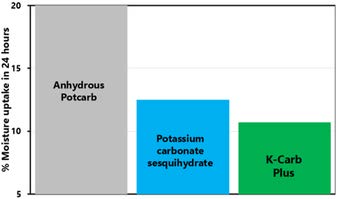
In the past, Barentz Animal Nutrition conducted research comparing the storage stability of potassium carbonate products
when exposed to humid conditions (Figure 1). Repeatably, K-Carb Plus® is much less hygroscopic than common PotCarb and similar
in stability to a leading potassium carbonate sesquihydrate. A long-term objective of Barentz Animal Nutrition is to better
understand how potassium carbonate behaves inside of dairy blends when milling conditions are humid. One key goal of this
work would be to better advise dairy formulators with development of mixing and storage SPOs around using potassium carbonate in
dairy blends. The laboratory work described below is an initial attempt to better understand the actual behavior of potassium
carbonate products in typical blends.
Overview of potassium carbonate mixing and storage tests:
There were two primary objectives of this work: 1) to understand what type of complex dairy blends might
be the most problematic when feed-grade Potcarb is used in the mix; 2) to understand if feed-grade
Potcarb and branded (stabilized) potassium carbonates differed in their chemical behavior when mixed into
these blends. All testing was accomplished in bench top set-ups where heat production could be monitored
closely, both in the mixer and during short-term storage of test blends.
The proprietary dairy blends tested included an 11-lb per head protein-mineral blend, a 6-lb per head
protein-mineral blend, and a 4-lb mineral blend. All blends included either sodium bicarb or sesquicarbonate
at relatively high levels (about 0.75 to 1.0 lbs per head). All blends also contained urea and bypass amino
acids and two of the blends contained liquid methionine, an acidic and very reactive material. As such, we
judged these blends to cover a range of potential reactivity with potassium carbonate products. The
branded potassium carbonates tested included K-Carb Plus® and a potassium carbonate sesquihydrate. KCarb
Plus is produced by coating granular 56% Potcarb with hydrogenated vegetable oil, greatly increasing
product stability in blends with the economic advantage of having a higher K content (53%) than a
sesquihydrate (46 to 48% K).
What did we find relative to the test dairy blends?
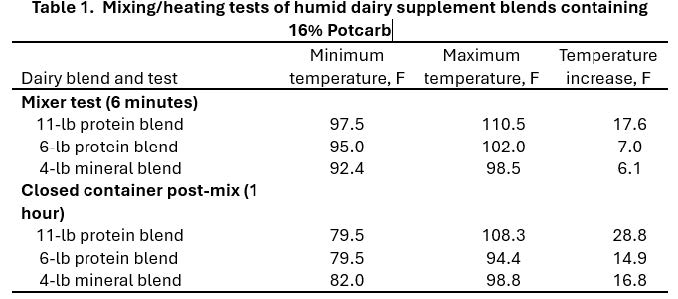
To simulate “worst case” blending conditions, the three dairy blends were lightly dampened prior to being
mixed with Potcarb over a 6-min mix time. The hypothetical per cow dose of Potcarb in each blend (16% of
the mix) was not intended to be real-world but rather to yield clearly discernible results. Surprisingly, the
more diluted 11-lb protein blend showed much greater heat production in mixing and in short-term storage
than the more dense blends (Table 1). The 11-lb mix was about 2/3 bypass soy protein and soybean meal.
The possible lesson here is that, with a lower concentration of minerals, the moisture added to the blend
was more available (free water) to interact directly with potassium carbonate to cause heating. In any event,
because of its greater heating potential, the 11-lb blend was used in later comparisons of Potcarb levels
(Table 2) and when comparing stabilized potassium carbonates (Figure 2).
What did we find relative to feed-grade Potcarb inclusion levels?
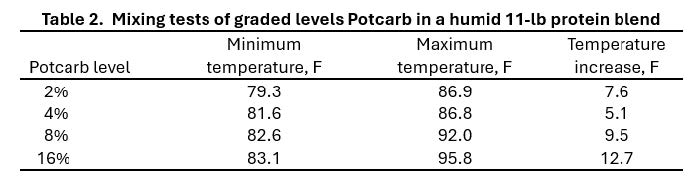
As described above, graded levels of Potcarb were mixed into the lightly dampened 11-lb dairy blend. As
shown in Table 2, even the 2% inclusion of Potcarb had a significant temperature increase during the 6-
minute mix. Although the 16% Potcarb level was many times higher than the 2% level, it was only about
2/3 higher in temperature increase to 12.7 F. At the higher level of 16%, there may be fewer reactants
(including water) to boost the temperature further. However, some of the Potcarb that does not react in
mixing may continue to react in the mix during transport and storage. In short, these data suggest that there
is no level of common Potcarb that is totally safe from heating if moisture is present during milling.
What did we find when comparing branded, stabilized potassium carbonates?
In these tests, Potcarb was compared with K-Carb Plus® and a leading potassium carbonate sesquihydrate
when each material was included at 10% of a mix with the 11-lb supplement. As expected, the temperature
of the mix increased immediately when the K source was common Potcarb (Figure 2). Both of the branded,
stabilized potassium carbonates showed slight heating of the mix, after an initial delays. It appears that either
stabilized potassium carbonate would perform acceptably at this high level of potassium carbonate inclusion.
Generally, it would be recommendable that any potassium carbonate source still be included at levels less
than 10%. In addition, other mixing SOPs, such as adding potassium carbonate to the blend last, should
continue to be followed.
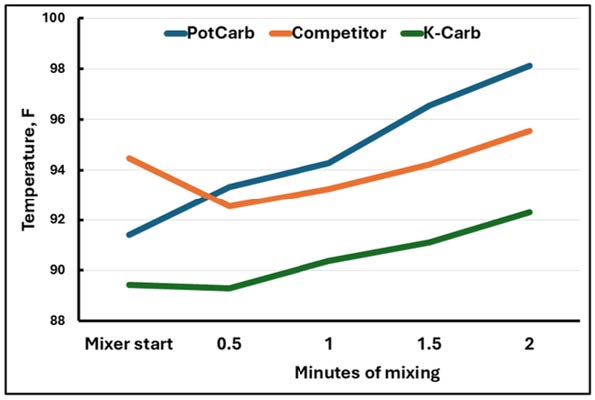
Figure 2. Initial heating during mixing of feed-grade Potcarb vs branded stabilized potassium carbonate
products when included at 10% of the mix